

Plywood Buying Guide 2026: Making the Right Choice for Your Home
Choosing plywood used to be simple—you just asked for “Commercial” or “Waterproof.” In 2026, the market is flooded with variations like Calibrated Plywood, BWP (Boiling Water Proof), and Fire-Retardant grades.
Whether you are planning a luxury villa construction or a modular kitchen interior, choosing the wrong plywood can lead to sagging shutters, termite infestations, or furniture warping within just 2-3 years.
Pro Buyer’s Summary 2026:
- Kitchens/Bathrooms: Use BWP IS 710 Marine grade only.
- Wardrobes/Beds: BWR IS 303 is sufficient; use 18mm for frames.
- The ‘Calibrated’ Advantage: Always demand calibrated plywood for a smooth, bubble-free laminate finish.
- Termite Protection: Look for “Anti-Termite” factory-treated certifications.
1. Quick Buying Matrix: Which Plywood for Where?
| Area / Usage | Recommended Grade | IS Code | Why? |
|---|---|---|---|
| Modular Kitchen | BWP / Marine | IS 710 | Heat, steam, and daily water exposure. |
| Wardrobes (Main) | BWR Grade | IS 303 | Structural stability and moisture resistance. |
| Beds & Sofas | BWR Grade | IS 303 | High load-bearing capacity required. |
| TV Units / Wall Panels | MR Grade | IS 303 | Dry areas; cost-effective Choice. |
| External Doors | Marine Grade | IS 710 | Direct exposure to rain and sunlight. |
2. Plywood vs. Block Board: Know the Difference
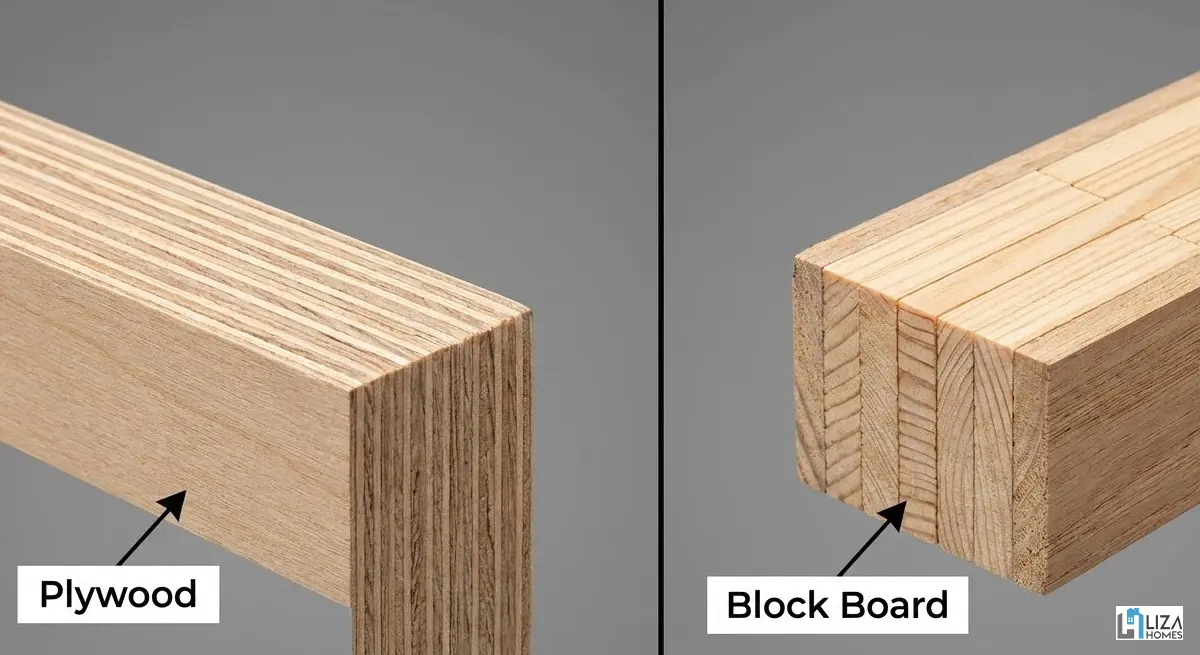
Many homeowners confuse Plywood with Block Board. In 2026, the distinction is vital for vertical vs. horizontal surfaces:
- Plywood (Veneered Sheets): Made of multiple thin layers. It has high screw-holding strength and is resistant to warping. Best for: All furniture carcasses, shutters, and kitchen cabinets.
- Block Board (Solid Wood Core): Contains a core of solid wood strips (usually pine or poplar) sandwiched between veneers. It is lighter and doesn’t sag over long spans. Best for: Long shelves (over 3 feet), tall wardrobe doors, and long table tops.
| Feature | Plywood | Block Board |
|---|---|---|
| Structure | Multiple cross-bonded layers | Solid wood strips (Pine/Poplar) |
| Resistance to Bending | Excellent (Short spans) | Superior (Long horizontal spans) |
| Screw Holding | Very High | High |
| Common Use | Functional carcasses | Doors & long tabletops |
3. The 2026 Health Standard: Formaldehyde Emissions (E0 vs. E1)
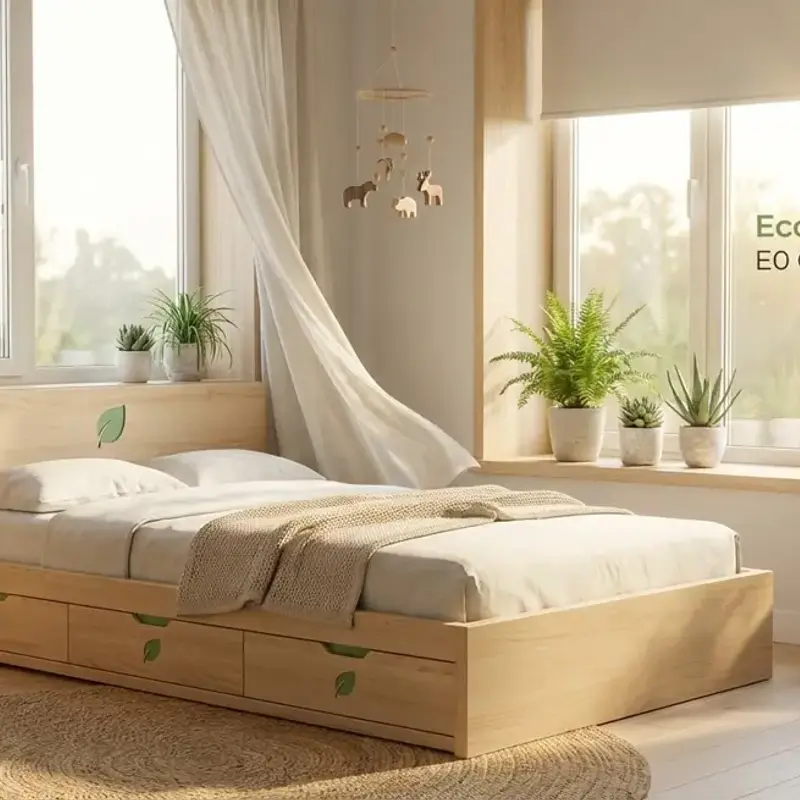
A major shift in 2026 is the focus on Indoor Air Quality (IAQ). Plywood uses resins that emit Formaldehyde, a toxic gas.
- E0 Grade: The highest international standard (virtually zero emissions). Mandatory for hospital interiors and highly recommended for kids’ bedrooms.
- E1 Grade: The standard for eco-friendly homes (low emissions). Most premium Indian brands now offer E1 as their baseline.
- E2 / Unrated: High emissions. Often found in local, unbranded plywood. Avoid these for bedroom interiors to prevent long-term respiratory issues.
2026 Brand Certification Matrix (E0/E1)
| Brand | E0 Certified Range (Best for IAQ) | E1 Baseline (Eco-Standard) |
|---|---|---|
| CenturyPly | Architect Ply | All premium ranges |
| Greenply | Green Club Plus 700 / Zero Emission | Baseline premium lines |
| Austin Plywood | Lincoln E0 Series | Club / Gold Ranges |
| Kajaria Plywood | — | KajariaPLY Silver Series |
4. Understanding Manufacturing Quality (The ‘Inside’ Story)
The strength of plywood lies in how it’s manufactured. Here is what defines a “Premium” sheet in 2026:
Core Timber Species
- Gurjan (Premium): Dense, heavy, and naturally resistant to termites. Recognizable by its reddish-brown core layers.
- Eucalyptus (Mid-Range): Strong and stable; the most common choice for “Pro” brands in 2026.
- Poplar (Budget): Lighter and softer. Often used in cheaper, unbranded plywood. Avoid for load-bearing furniture.
Glue & Pressing Technology
Modern 2026 manufacturing uses Quad-Press Technology (pressing the core twice and the face twice). This ensures there are Zero Core Gaps. If you see gaps between the layers at the edge of a sheet, reject it—it will lose its screw-holding strength.

5. The 18mm vs 12mm vs 6mm Guide
Don’t let your contractor use the same thickness everywhere. Optimize your budget with this application-focused breakdown:
| Furniture Application | Recommended Thickness | Recommended Grade |
|---|---|---|
| Kitchen Base Cabinets | 18mm | BWP (IS 710 Marine) |
| Wardrobe Body/Frames | 18mm | BWR (IS 303) |
| Wardrobe Shelves | 12mm or 15mm | BWR (IS 303) |
| Back Panels / Drawers | 6mm or 9mm | MR / BWR |
| Tall Wardrobe Doors | 19mm Block Board | IS 1659 |
| TV Unit Panels | 12mm | MR (IS 303) |
| Bed Boxes | 18mm | BWR (IS 303) |
6. IS Codes: Your Shield Against Fake Plywood
In India, “Waterproof” is the most misused term in the timber market. Use this translation table to verify the stamp on your sheets:
| IS Code | Common Market Name | True Water Resistance |
|---|---|---|
| IS 710 | Marine Grade (BWP) | 72 hours in boiling water (Strictly Waterproof). |
| IS 303 (BWR) | Waterproof Plywood | 8 hours in boiling water (Moisture Proof). |
| IS 303 (MR) | Commercial Plywood | Only resists humidity; swells in direct water. |
| IS 5509 | Fire Retardant | Resists ignition and spread of fire. |
| IS 1659 | Block Board | Structural grade for long spans. |
Pro Tip: If the stamp doesn’t have the “CM/L” license number along with the IS code, it is likely a local copy. Verify the license on the BIS app.
7. Top Brands vs. Local Plywood in 2026
While local plywood is 30% cheaper, the 20-year durability of branded plywood often outweighs the initial savings.
- Tier 1 Brands (Century, Greenply, Kajaria Greens): Offer lifetime warranties, E0/E1 compliance, and strictly calibrated thickness.
- Tier 2 Brands (Austin, Trojan, Sarda): Excellent value-for-money, often providing Gurjan alternate cores with 20+ year warranties.
- Unbranded Local: No warranty, inconsistent thickness, and risk of core gaps. Only use for temporary structures.
8. 2026 Quality Checklist for Homeowners
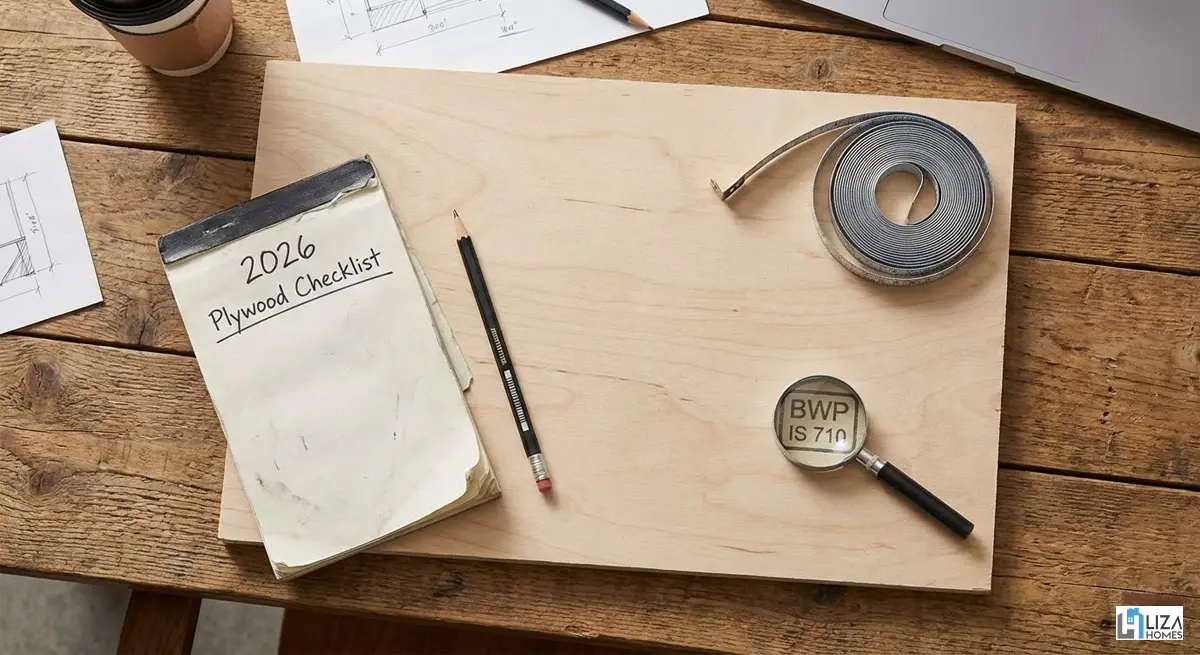
When the plywood arrives at your site, perform these 4 DIY checks:
- The Sound Test (Knocking): Knock on several spots. A sharp “thud” is good. A hollow ring indicates an internal gap.
- The Edge Audit: Look at the cut edges. The layers (veneers) should be straight and uniform. If the layers look wavy or have holes, the manufacturing is poor.
- The Squareness Check: Measure both diagonals. If the diagonals don’t match, the sheet is not a perfect rectangle, which will make your cabinets crooked.
- The Smell Test: Strong, pungent chemical smells indicate high Formaldehyde emissions—damaging to indoor air quality.
Maintenance Guide: Making Your Furniture Last 20+ Years
- Edge Banding: Ensure all cut edges are sealed with 2mm PVC edge banding to prevent moisture from entering the core.
- Pest Treatment: Even if the plywood is termite-proof, ensure the wall behind the furniture is treated for termites during construction.
- Avoid Overloading: Use Block Board for spans longer than 3 feet to prevent the “sagging shelf” look.
- Ventilation: Allow new furniture to air out for 2-4 days to let the initial Gasses (VOCs) dissipate.
Plywood Price Expectations (Estimate 2026)
Prices vary by city (Bengaluru vs Delhi) and brand, but here is a median range for 18mm thickness:
- Commercial (MR): ₹65 - ₹90 per sq.ft.
- BWR Grade: ₹95 - ₹125 per sq.ft.
- Marine (IS 710): ₹135 - ₹190 per sq.ft.
- Full Gurjan Marine: ₹210+ per sq.ft.
How Liza Homes Helps You Choose
At Liza Homes, we provide a complete Material Transparency Guarantee:
- Verified BOQs: We clearly specify the Brand, Grade, and Thickness for every room.
- Core Inspection: We invite clients to inspect the raw plywood at the site before laminate application.
- Health First: We prioritize E1 and E0 grade materials for all home interiors.
- Calibrated Only: We exclusively use calibrated plywood for modular kitchens to ensure perfect finishes.
Ready to build your dream home with the right foundation? Get a detailed material consultation with us today.
Sources & References
- Bureau of Indian Standards (BIS): Specifications for IS 303, IS 710, and IS 5509.
- IPIRTI (2025 Reports): Formaldehyde Emission Standards for Indian Plywood.
- National Building Code of India (NBC): Structural guidelines for modular furniture.
Recommended for You