
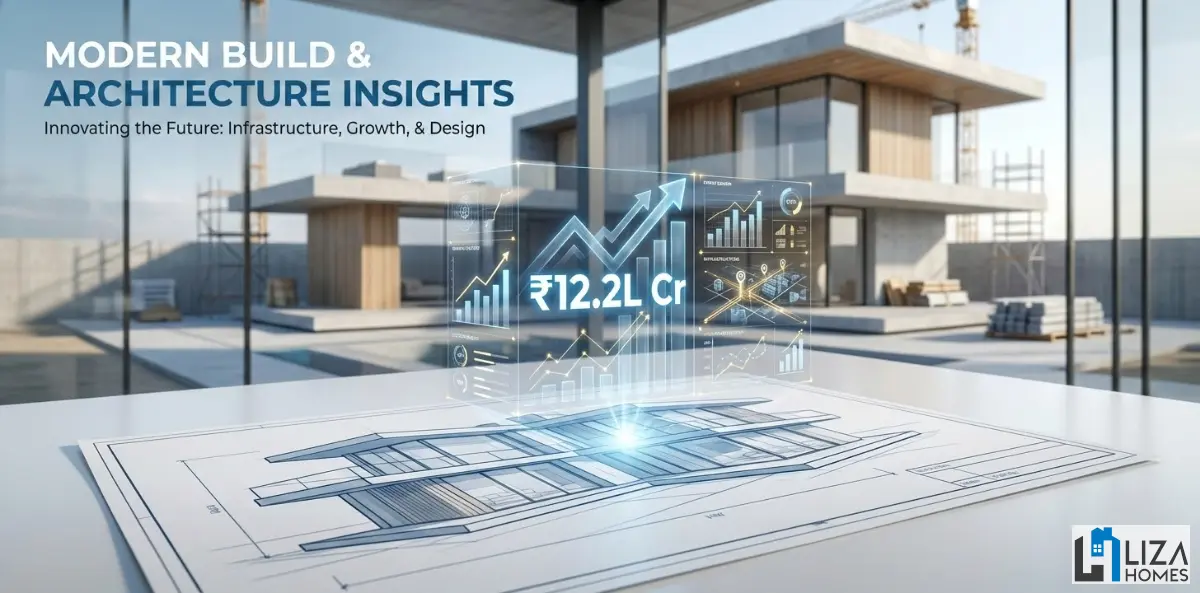
The Union Budget 2026-27, presented by Finance Minister Nirmala Sitharaman on 1st February 2026, charts a course for sustained economic momentum with a clear mandate: Infrastructure-Led Growth.
With a record-breaking ₹12.2 Lakh Crore outlay for Capital Expenditure (~9% rise), the message for India’s built environment is loud and clear: Build high-performance, build sustainable, and build smart. For architects, engineers, designers, and homeowners, this is the definitive technical roadmap for 2026.
🚀 Budget 2026: The "Power Pillars"
- 🏗️ Infrastructure Surge: ₹12.2 Lakh Cr (Investment in roads, rail, and Tier-2/3 expansion)
- 🛡️ Risk Mitigation: New Infrastructure Risk Guarantee Fund to de-risk private financing
- 🌱 Green Mandates: ₹20,000 Cr for Carbon Capture in Cement & Steel production
- 🤖 AI-First Design: Strategic focus on AI-based Civil Engineering and Computational Design
- 🏢 REITs Expansion: Unlocking capital through REIT structures for public real estate assets
🏗️ 1. Engineering: The Infrastructure Risk Guarantee Fund
A game-changer for the construction sector, the Infrastructure Risk Guarantee Fund addresses construction-phase risk concerns by offering partial credit guarantees to lenders.
- Financial De-risking: Lenders gain confidence in large-scale residential and commercial projects, leading to reduced financing costs for developers.
- Engineering Alpha: Smaller engineering firms stand to benefit indirectly, as increased liquidity flows enable more design-and-build contracts.
- Green Materials: With ₹20,000 Crore diverted to low-carbon production, Specifying “Green TMT Bars” and “Eco-Cement” is moving from an elective to a standard specification.
📐 2. Architecture: AI-Driven Design & Urban Connectivity
The budget signals an “AI-First” approach to urban planning, transforming architects from drafters to computational designers.
- Computational Design: The new AI-first design curriculum focus means AI will now optimize sun-path, wind-flow, and spatial efficiency at the blueprint stage.
- Tier-2 & Tier-3 Surge: Massive funding focus outside metros opens opportunities for architects to design “Smart & Efficient” housing in emerging growth centers.
- Landscaping & Public Spaces: Increased capex across civic infrastructure translates into more large-scale urban design and landscaping projects.
🛋️ 3. Interior Design: Sustainability & MSME Synergy
Interior designers are seeing a budget that favors durability and performance over fleeting luxury.
- Circular Economy: Performance-based design is the new goal. The budget’s focus on MSME manufacturing makes high-end Indian-made Vitrified tiles and Veneers significantly more cost-effective.
- Smart Integrated Hubs: The push for energy efficiency is driving a market for built-in sensors and energy-harvesting systems within interior packages.
🏠 4. Impact for Home Owners: What’s in it for You?
For the Indian homeowner, Budget 2026 is about stability and speed.
- Faster Construction: De-risking financing means developers can complete projects without the traditional “liquidity crunch” bottlenecks.
- Infrastructure Wealth: The ₹3.90 Lakh Cr allocation for Rail & Urban connectivity means peripheral areas in cities like Bengaluru will see rapid appreciation in property value.
- REIT stability: Broadening the REIT market for CPSE properties unlocks capital and improves overall real estate liquidity, ensuring longer-term market stability.
The Verdict: Execution-Centric Development
The Union Budget 2026-27 effectively removes the boundaries between Architecture, Engineering, and Design. It moves India from “Plan-Centric” to “Execution-Centric” development.
At Liza Homes, we have already integrated these budget shifts—from de-risking infrastructure to AI-informed design—into our 2026 Build Strategy. When you build with us, you are not just building a house; you are engineering a high-ROI asset for the future.
Related Resources
- The Zero-Water-Bill Villa Blueprint
- 30x40 House Construction Cost 2026
- Interior Design Mistakes to Avoid in 2026
Published by the Liza Homes Editorial Team. Last Updated: February 13, 2026. Data sourced from Union Budget 2026-27 analysis.
Recommended for You