
If you live in Bengaluru, you know the sound. The groaning reverse-gear beep of a heavy truck navigating a narrow residential street at 6 AM. It’s the sound of the water tanker arriving—the soundtrack of anxiety, rationing, and escalating costs.
For decades, building a luxury home here meant importing Italian marble and installing German kitchens. By 2026, the definition of luxury has shifted radically. True luxury is autonomy. It is the peace of mind that comes from knowing that no matter how dry the Cauvery gets, or how high tanker prices spike, your home remains an oasis of abundance.
We are no longer talking about just “saving water” with a token recharge pit. We are talking about building a machine for living that generates, recycles, and manages its own water supply 365 days a year.
📖 Table of Contents
🚀 The "Zero-Reliance" Blueprint
Forget basic rainwater harvesting. This is about integrating decentralized sewage treatment, dual-piping, and atmospheric generation to future-proof your lifestyle against the water crisis.
Pillar 1: The Foundation – Aggressive Rainwater Harvesting (RWH 2.0)
In 2026, standard RWH compliance is meaningless. A Zero-Reliance villa doesn't just "harvest" rain; it aggressively hoards it.
Bengaluru receives decent annual rainfall, but it falls in intense bursts. The old strategy of small tanks and recharge pits lets 80% of that water escape.
The Strategy: You need massive underground sump capacity—think 50,000 to 100,000 liters for a large villa, depending on roof area. This isn’t just a tank; it’s an engineered reservoir with multi-stage filtration (sediment, carbon, UV) that turns monsoon runoff into near-potable water stored in cool underground concrete chambers, preserved for the dry months between January and May.
Pillar 2: The Game Changer – Decentralized Sewage Treatment Plants (STP)
This is where the true water-independent homeowners separate themselves.
Historically, STPs were noisy, smelly industrial units for massive apartment complexes. Today, compact Membrane Bioreactor (MBR) technology allows a single villa to process its own “black water” (toilet waste and kitchen waste) silently and odor-free in a basement corner or underground chamber.
Why do it? An STP treats your foulest wastewater to a level that is perfectly safe for gardening and, crucially, flushing toilets.
Pillar 3: The Circulatory System – Dual-Piping
An STP is useless if you don't have a way to move the treated water around. This must be planned before the foundation is poured.
A dual-piping system involves laying two entirely separate sets of plumbing lines throughout the house:
- The Blue Line (Potable): Supplies fresh, treated rainwater or AWG water to showers, kitchen taps, and washbasins.
- The Purple Line (Recycled): Supplies treated water from your STP and greywater systems specifically to toilet flush tanks and outdoor irrigation taps.
The Impact: Flushing toilets accounts for nearly 30-40% of daily household water usage. By using recycled water here, you instantly slash your fresh water demand by almost half.
Pillar 4: The "Magic" Source – Atmospheric Water Generators (AWG)
Your emergency gold reserve for drinking water.
If RWH is your seasonal savings account, and the STP is your daily checking account, the Atmospheric Water Generator is your emergency gold reserve.
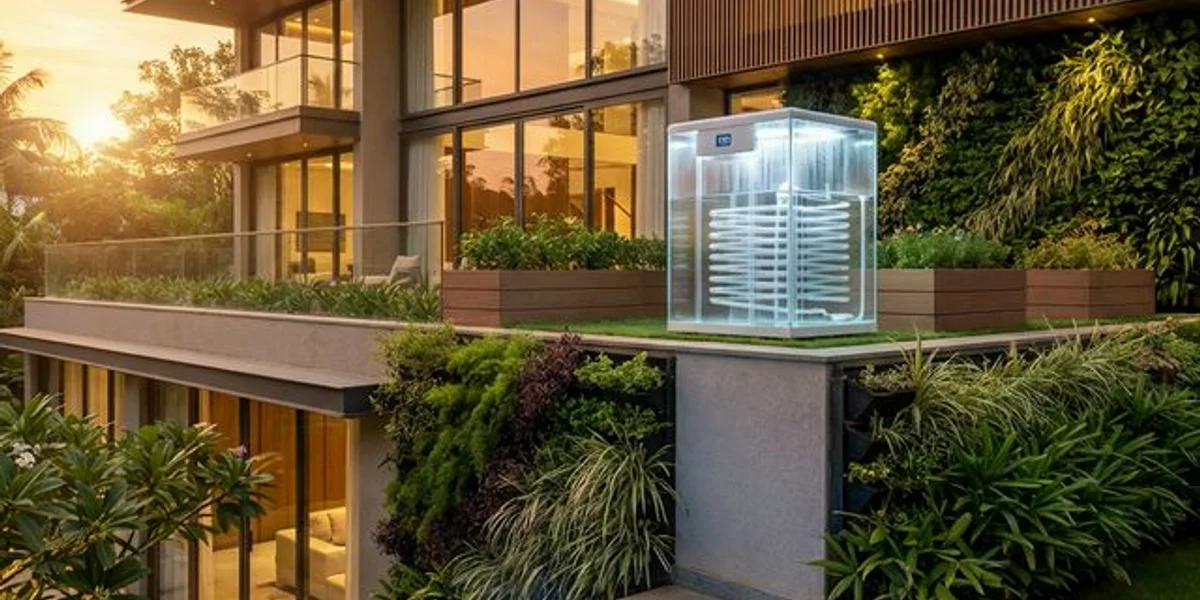
AWGs are appliances that extract humidity from Bengaluru’s air, condense it, filter it, and mineralize it into absolutely pure drinking water. In 2026, these units are highly efficient. A household-sized AWG can generate 30-100 liters of pure drinking water daily, powered by your villa’s solar array.
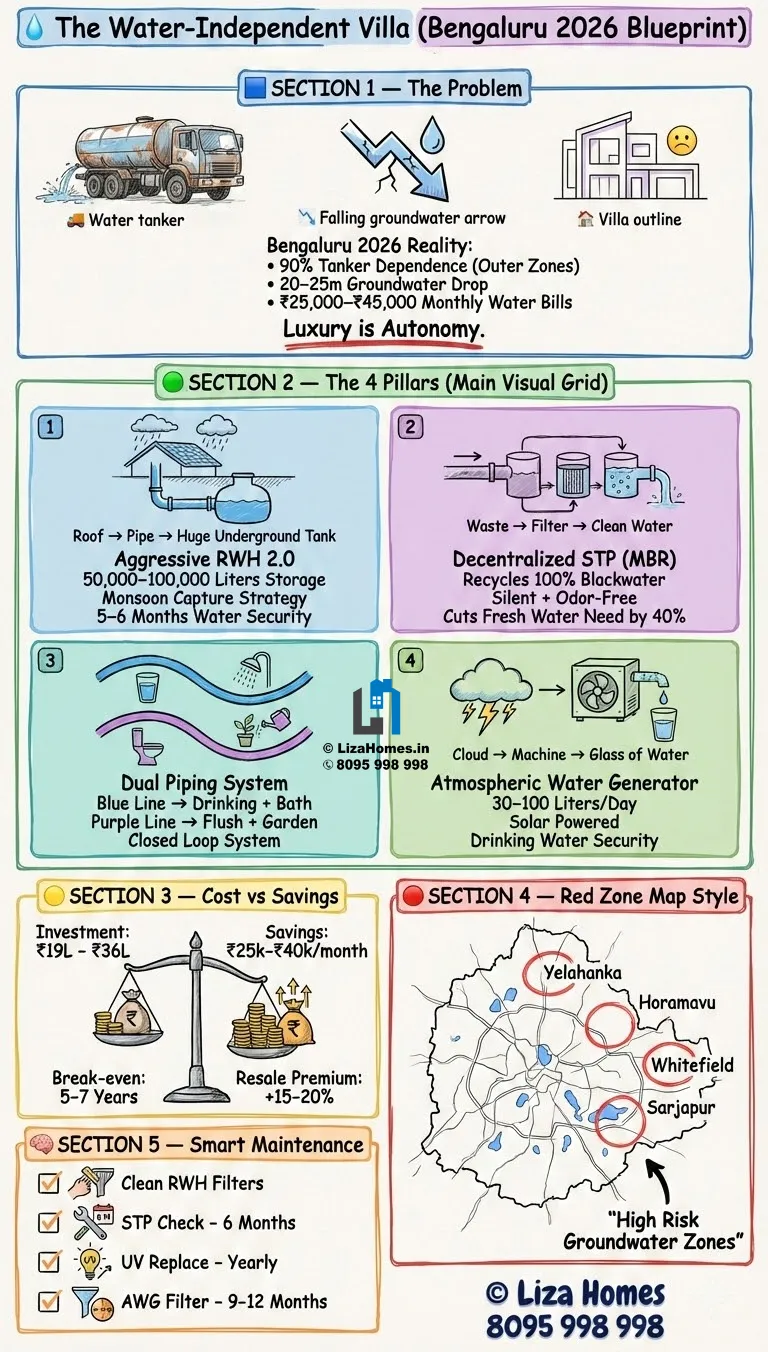
Infographic: The Zero-Reliance Blueprint for sustainable luxury villas in Bengaluru.
The 2026 Crisis Outlook: Why “Business as Usual” is Failing
According to a joint study by the BWSSB and IISc (Indian Institute of Science), Bengaluru’s water vulnerability is reaching a tipping point. Groundwater levels in areas like Whitefield, Sarjapur, and Bommanahalli are predicted to drop by an additional 20-25 meters by mid-2026.
With the city’s population projected to hit nearly 1.5 crore by 2031, the reliance on the Cauvery Stage V project alone is insufficient. For villa owners, the message from the research is clear: The grid cannot save you—you must save yourself.
Real-World Proof: Bengaluru's Water Legends
You don't have to be a pioneer; these homeowners have already proved it works.
- Case Study 1: AR Shivakumar (“Sourabha”): A legendary example in Vijayanagara. For over 28 years, this family has had zero municipal water connection. By harvesting 2.2 lakh liters from a 60x40 plot, they meet all needs entirely through rain.
- Case Study 2: Suma Raj (Royal Placid Layout): In 2020, they invested in a 70,000-liter underground reservoir. They have successfully managed three consecutive peak summers without calling a single tanker.
- Case Study 3: The “Mud Home” (Jaya): This residence recycles 800 liters of greywater daily using a reed bed system, proving that even a single home can run a professional-grade circular water economy.
Regulatory Compliance: The 2026 Mandates
Building a Water-Independent Villa isn’t just a choice—it’s increasingly the law. BWSSB has strictly enforced the following for 2026:
- Mandatory RWH: Any new building on a 30x40 (1,200 sq. ft.) plot or larger MUST have a functional RWH system to receive an Occupancy Certificate (OC).
- Dual-Piping (Proposed 2025/26): New policies require independent villas to incorporate dual-piping to separate potable water from recycled greywater for flushing and gardening.
- STP Penalties: Non-compliance with recycling norms in large residential units now carries a 50% additional levy on water and sanitary bills.
Cost-Benefit Analysis (2026 Outlook)
Integrating these systems is a significant upfront investment, but the ROI in Bengaluru’s reality is rapid.
| System Component | Estimated Implementation Cost | Primary Benefit | The “Zero-Reliance” Dividend |
|---|---|---|---|
| Aggressive RWH + Huge Sump | ₹8 Lakh - ₹15 Lakh | 5-6 months of total supply | Eliminates tanker reliance in monsoon. |
| Decentralized STP (MBR) | ₹6 Lakh - ₹10 Lakh | Recycles 100% of black water | Reduces fresh water demand by ~40%. |
| Dual-Piping Plumbing | ₹2 Lakh - ₹4 Lakh | Infrastructure for recycled water | Enables the closed-loop system. |
| Atmospheric Water Gen (AWG) | ₹3 Lakh - ₹7 Lakh | 50L+ pure drinking water daily | Absolute security against municipal issues. |
📍 Neighborhood Watch: Is Your Area at Risk?
The 2026 forecast shows that groundwater levels in peripheral Bengaluru are dropping by **20-25 meters** annually. If you are building in these high-vulnerability "Red Zones," water independence is not a luxury—it is survival.
High Groundwater Depletion
90% Tanker Reliance
Zero Cauvery Connection
Deep Borewell Failure Risk
Traditional vs. Zero-Reliance: The 2026 Reality Check
| Feature | Traditional Luxury Villa | Zero-Reliance Masterpiece |
|---|---|---|
| Water Source | 80% Tankers + 20% Borewell | 100% Self-Generated (Rain + AWG) |
| Recycling | Basic Garden Reuse | Full Blackwater-to-Potable Cycle |
| Operational Effort | Constant Tanker Tracking | Fully Automated Smart Control |
| Resale Premium | Market Average | 15-20% Green Premium |
| Monthly Bill | ₹25,000 - ₹45,000 (Surging) | ₹0 (Powered by Solar) |
The Tech Stack: What Goes Into the Loop?
We use industrial-grade technology scaled down for the sophisticated villa owner.
To achieve true independence, we integrate specific components that have become the standard in 2026:
- MBR (Membrane Bioreactor) STP: Unlike old STPs, MBR units use microscopic membranes to filter out bacteria and viruses, producing water that is crystal clear and odor-free.
- Ultrafiltration (UF) & UV: The final stage for rainwater, ensuring it is safer than municipal supply.
- Smart Water Metering: Real-time tracking of every drop on your smartphone.
- High-Yield AWG (Atmospheric Water Generators): Brands like AKVO or Airowater now offer residential units that generate 50L/day using only humidity and solar power.
Maintenance: The "Set and Forget" Schedule
A common myth is that these systems are hard to maintain. In 2026, most functions are automated. Here is your required owner-checklist:
| System | Action Item | Frequency |
|---|---|---|
| Rainwater Filter | Clean first-flush diverters | Every 3 heavy rains |
| STP System | Professional system health check | Every 6 months |
| UV Filters | Replace UV lamp & UF membrane | Once a year |
| AWG Unit | Replace air and mineralization filters | Every 9-12 months |
| Tank Integrity | Sump sediment cleaning | Every 2-3 years |
📸 Shareable Checklist: The Water-Independence Audit
- ✅ Is your sump capacity at least 0.5L per sq. ft. of plot area?
- ✅ Do you have separate plumbing for greywater?
- ✅ Is your RWH filter a "High-Capture" type?
- ✅ Have you allocated space for a compact MBR STP?
- ✅ Is your solar capacity sized to run a 24/7 AWG?
Hit 5/5? You’ve built a future-proof asset.
Conclusion: Future-Proofing Your Lifestyle
Building a home in Bengaluru today without these systems is fundamentally planning for future stress. The “Water-Independent Villa” isn’t just an eco-friendly concept; it’s a pragmatic response to environmental reality. It shifts the narrative from scarcity to abundance.
Build the blueprint. Close the loop. Silence the tankers.
Related Reads
- Revised Setback Rules in Bengaluru 2026
- 30x40 House Construction Cost Bengaluru 2026
- Is Your Bengaluru Plot Buildable?
Last updated: February 2026. Sources: BWSSB 2026 Mandates, IISc Water Security Report, AR Shivakumar Case Study. For a precise estimate or engineering consultation, contact our team or use our AI construction cost calculator.